Monday, August 25, 2014

Two Field Cricket Recipes

I've been experimenting with ways to keep my personal costs down as well as reduce my environmental impact (which, as an unashamed meat-eater, is difficult).  One of the ways I've been dealing with that is through eating a widely available resource in my front yard:  Field crickets.

In the United States this isn't exactly a popular snack, relegated to ridiculously overpriced boxes of snacks that are basically meant as a quirky gag gift for the person who will eat anything, but around the world insects have been an important part of the food supply.  I recently ordered the Eat-A-Bug Cookbook by David Gordon, and although it doesn't have that many good paleo recipes, it did have some good information on harvesting.  See, I'd always been told never to actually harvest wild insects for eating.  I found out recently that the two main issues are parasites (which are killed off by cooking) and chemicals (which, although I'm sure they're present, shouldn't be that abundant in my scrubby mostly-weeds-and-no-pesticides-ever lawn).  As most paleo eaters I know are (unlike me) in the city, then it might be a better idea for you to buy house crickets from a pet shop instead, which is the prevailing advice among most entomophagy buffs I've encountered.

Again, since insect recipes tend to be very non-paleo, I've decided to start developing some more paleo options.  Here are the first two I'm comfortable with:

Garlic and Cayenne Crispy Crickets

This is barely a recipe, to be honest, and if you look for cricket recipes at all you will likely find variations on this in abundance.  Still, out of the two I'm presenting you today, this is the most unexpectedly tasty.

Gather a bunch of crickets depending on how many you can acquire (again, I am pretty much limited to what I find in my lawn, and pet store crickets are expensive).  Put them in the freezer--alive--for about ten or twenty minutes (I've found putting them in for ten will slow their metabolism but not kill them, after twenty they should be dead; this is up to personal preference).  Take them out and rinse them in cold water, straining it off with a colander.

Dust the crickets with garlic powder, cayenne pepper, and salt.  I used maybe 3 parts garlic, 2 parts salt, and 1 part cayenne.  This will vary a lot by taste.

Spread the crickets on a cookie sheet (actually I used a slow cooker pan, but I also didn't make too many).  If they start moving... don't worry too much.  They probably won't go anywhere.  Roast them at 200oF for two hours, or until sufficiently crispy.  Eat as a snack or use as an ingredient in other dishes.

The legs can get annoying.  If they annoy you, you can choose to roll them gently between your hands after they're cooked.  The legs will crunch right off.  I, however, do not consider them particularly bothersome.

Field Cricket and Flaxseed Broccoli
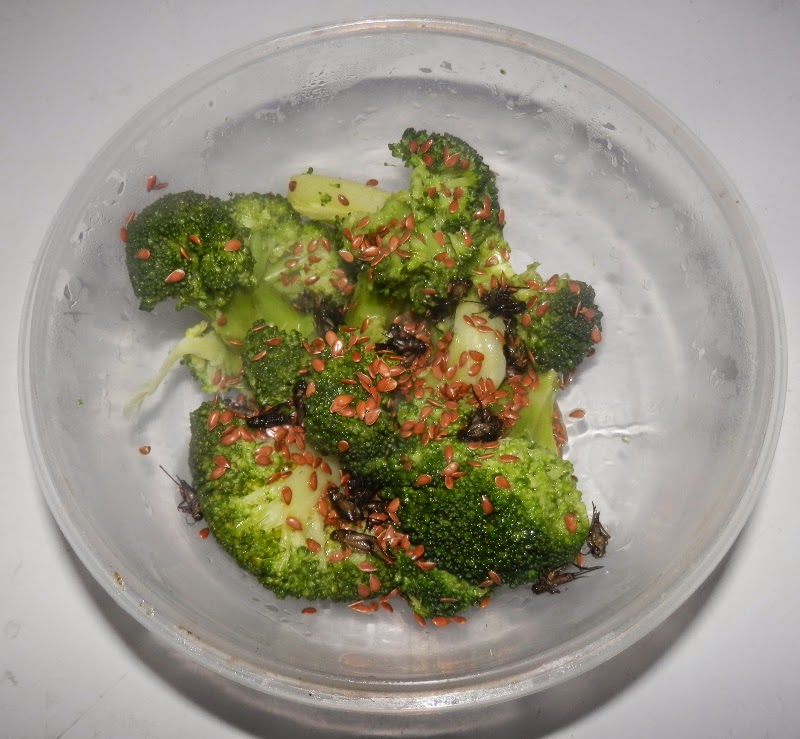
Admittedly a lot of my recipes involve putting things on broccoli.  I think I already posted my recipe for flax seed broccoli, which I ate every damn day for probably two weeks a while ago.  It's easy:  Just add flaxseeds, sliced almonds, and extra virgin olive oil to broccoli.  Eat.

This is a variation on that, but instead of sliced almonds, I added sautéed field crickets and butter.

FYI: Crickets actually taste like a bizarre mix between shrimp and almonds anyway.  So it made perfect sense.

The sauté was done in some light olive oil and very briefly.  Crickets are tiny and therefore cook fast.  Meanwhile I made the broccoli and added a tablespoon of brown flaxseeds and a half tablespoon of Kerrygold Irish butter.  The crickets were placed on top of that.

This dish wasn't bad, but the problem is as follows:  The crickets didn't really add anything except protein.  And yeah, that's great, but if I'm going to add something I want to taste it.  I think if I did this again, I'd actually add the crickets from the recipe above instead of just sautéing them.

Sunday, August 10, 2014

My Transition Timeline So Far

I've been having lots of fun posting recipes and ranting about dipshits who talk about paleo without understanding it, but I feel like I'm somewhat neglecting the whole "transgender" aspect of this blog, so I'm going to talk about my physical and emotional transition so far, starting with some basic social stuff and then getting into some more physical changes.  The last category is health issues.

The Social Transition

I came out in late 2003.  By the time I began hormones, I was mostly socially transitioned already.  What this means is I was out to my friends and family, most of them were calling me male pronouns and my new-ish name (my new name is extremely similar to my birth name and so this should not have been a challenge; family members still struggle with pronouns), I was working as a man, and I'd even already gotten my driver's license changed (which in the state of Wisconsin only requires a note from a therapist).  So I was already in a good place socially when I began hormones on December 22, 2011.

Part I: Obvious Physical Changes

The picture below is my "timeline," or a line of images from various points in my transition where I tried to keep the same facial expression and such.  I lost my glasses so I didn't wear them last time.  It's still a good depiction of the rate these changes went at.


The most rapid, obvious change was face shape and texture.  My skin lost a lot of its "softness" in the first few months, and within the first two weeks I got what I called "wax face."  My face would get ridiculously shiny, and washing would not help it.  It didn't feel oily, it just looked oily.  It was oddly enough not accompanied by an increase in facial acne.  Oh, and a few days after I started shots I got this horrid rash on my face.  I remember it was Christmas Day because the only thing open was Walgreens and I did manage to get something to help it a bit.  It went away in a couple days.

This was probably 1 month or so on T.
I occasionally still get oiliness, but--surprise--this has been helped a lot with diet.

As you can see from the timeline picture, between Pre-T and 7 months my jawline appears to change (this is likely due to the change in musculature testosterone will grant you).  Basically my face squares up and fills out a bit.

Next came facial and body hair.  You can see that I do have visible facial hair on my chin at 7 months.  Technically I already had a little pre-T, which I called my "vampire bites."  Just a little patch on each side.  I believe it got to the point where I could keep some there without it looking weird after about four or five months, although it would take around a year and a half for it to get to a point where it looked like an adult man's goatee.

Within the past couple months, my cheeks are finally starting to grow hair, too.  I am kind of curious about whether or not it would actually look like a full beard and not a small goatee with a bunch of patchy shit around it, but there are social complications (by which I mean I may or may not want to be able to continue having sex with somebody who may or may not dislike beards).

Body hair I didn't even notice at first, because even before testosterone I had a lot of it.  Basically, several months into the meds, I looked down one day and realized I'd turned into a goddamn bear in the meantime.

Finally, there's a lot of veinage in my hands, and... I'm a full two inches taller.  This shocked me, because I'd always been told "your long bone grown ends in your early twenties, if you go on T at 27 you're not going to grow anymore."  So it's not growth of long bones, it's other factors.  I lost the tendency to slouch long before testosterone (although I still do it when I'm in public and not binding).  Some have told me it's due to an increase in cartilage density.  I don't know.  I just know that it happened.

Part II: Vocal Changes

Here's the weird part about vocal changes:  I didn't really notice them that much.  Everyone else noticed them, but I was pretty oblivious, and it took well over a year for me to actually be confident that my voice is easily distinguishable as a man's voice.  My personal theory about this is that since I live with myself 100% of the time the vocal changes.


Around two or three weeks I "sensed" my voice changing, and my videos do confirm it... barely.  My voice was just a little scratchy.  So who knows?

Starting around a month and a half things started rapidly changing.  This was when my voice started really cracking up a storm and people started acting like things were changing.

Three months was all it took for me to be read as male over the phone.  This was also about the time I started "passing" full-time and kind of lost interest in documenting my voice (I apologize).  I am aware that from that point until maybe a year in my voice gradually got deeper, but I didn't really notice.

Part III: Health Issues

I had some really standard health problems that people go over whenever they put a trans man on testosterone.  My blood pressure raised by about ten points on each end after the first year... within the past four months it's been an unacceptable level and I've been gradually working on getting it down through paleo diet and exercise.  This made perfect sense, because I was unemployed between January and May, and the stress of going through that made me gain some weight.  I also had prediabetic-looking blood glucose, but I've tailored my diet specifically to deal with that.

I gained weight on testosterone, but I haven't reached the peak I was at when I finally left vegetarianism, which was just shy of 270 pounds. I currently weigh 234 (meaning I finally, just today, got back down to the weight I was at before my business trip).

My HDL and LDL?  Pretty much exactly the same.  I have iron lipoproteins.  It seems like no matter what I eat or what drugs I go on they're at a level accepted by any conventional doctor.

The one really concerning health problem brought on most obviously by testosterone supplementation--and probably kicked further by the paleo diet--was that I did get secondary polycythemia.  This means that the ratio of red blood cells to other blood components is shifted, with too many red blood cells.  This is potentially dangerous if left untreated, but the treatment is really simple:  Just get some blood out of there periodically.  This is usually achieved by regular blood donation (in a lot of contexts, if you're not eligible to give blood, they will still take the blood out if you have this condition).

Interestingly, when I was just looking into paleo, I read somewhere that people on the diet were donating blood under the assumption that our ancestors would have had more traumatic injuries.  I don't think this makes any sense at all, but I do know that I know more than average paleo eaters who have high iron and would benefit from blood donation (plus you benefit the world by it).

Anyway, that's it for now.  I'll have to come up with some more relevant trans health things in the future.  But in the meanwhile, expect more recipes.

Pecan and Flax Crusted Walleye

My dad and brothers brought back a bunch of walleye from the lake, and for some reason the phrase "pecan crusted walleye" was really stuck in my head, and I had ground pecans, so I decided to look up and modify a recipe for this dish.


The above were some fillets I baked. I actually preferred pan frying them in some butter, but the baked was also very good.

You need:
  • 1 pound walleye fillets
  • 1 cup ground pecans
  • 1/4 cup ground flax seed
  • 1 egg
  • 1/4 teaspoon garlic powder
  • 1/4 teaspoon paprika
  • salt and pepper to taste
  • 2 tablespoons healthy oil, such as grassfed butter or coconut oil (I used all grassfed butter, but I feel like half butter half coconut oil would be great) if pan frying.
Start by blending together the egg, garlic powder, paprika, and salt and pepper.  In a shallow dish, combine the pecans and ground flax until they're married together really nicely.

The rest of it is really simple.  Moisten the fillets all over and then dip in the pecan/flax mixture.  If baking, lay them on a pan (I used a roasting pan, but I use that for damn near everything).  Bake at 350oF for about twenty minutes, or until the flesh flakes easily with a fork.  If pan frying, heat the oil in a pan and then fry them a couple minutes on each side until--again--it flakes easy with a fork.

I spritzed each fillet with lime before eating.

This is really fragile when it comes to plating, so if you're trying to look fancy be warned that you're going to have to be really gentle with these when transferring from the pan to the plate.

Thursday, August 7, 2014

Angels on Horseback

I don't remember where I first learned about angels on horseback.  It was probably during a bizarre Victorian kick I went through a while ago.  Whatever the case, I love them, so I'm going to tell you about them.

Angels on horseback are oysters wrapped in ham or bacon and then either pan fried, broiled, grilled, or baked.  These ones I baked on a broiler pan.  They're ridiculously easy.

I just take half a strip of thin bacon (or 1/3 strip of thick bacon, although it doesn't work as nicely), wrap it around an oyster (I used canned ones for this one which is partially to blame for the creative coloring; you can obviously use fresh raw ones, I've also used canned smoked ones).  You can stick them on a pan and just let them bake like that un-pinned, but I prefer to use either a skewer or a toothpick to keep them from unraveling on me.  I typically bake at 400oF for about twenty minutes.

Eat them plain or with hot sauce.

As I'm looking at this, it strikes me that if you grilled them you could also add fruit, vegetables, or other meat and make them into full on shish kebabs.

A variant on this is the devil on horseback, which I've tried but am not quite as fond of.  These are made in almost exactly the same way, except instead of oysters you are wrapping bacon around a piece of fruit (usually a date or a prune, perhaps with an almond stuffed in it).

Thursday, July 31, 2014

Cherry Twig Chuck

So yesterday I made one of the best pieces of beef I've ever made. 


Cherry Twig Chuck
I had bought a chuck roast to cut into steaks.  I cut half of it into two steaks that I ate with a friend a couple days ago, then the other half I cut into what actually amounts to mini-roasts.  I think next time I do this I'll just grill a whole chuck roast.

Ingredients and supplies include:
  • A grill. Unless you have a tray that you can put wood chips in, this is not something you can make in an oven or frying pan.  It's grill food.  I used a propane grill.  You should be able to do it fine on a charcoal grill, too, but you'll have to tweak the recipe a bit.  The best grills for this have either a separate smoking area or have a top rack.
  • A chuck roast or chuck steaks (you can probably use other meat, too).  The lean parts turned out the best.
  • Garlic powder
  • Salt (I use Hawaiian Black Salt)
  • Black Pepper
  • Twigs from a cherry tree.
Start up the grill as per instructions and let it heat up.  Sprinkle the garlic powder and pepper on the steak.  I usually only put a little garlic powder on there, because garlic powder is just so strong to me.  Don't put the salt on, yet.

Put the meat on the grill.  I stick the cherry twigs on the grill at this point.

Leave them on there, flipping every so often, until they're good and browned all over, then transfer them to the top rack.  If you haven't put your cherry twigs on the grill yet, do that so that it really starts filling the area with smoke.  Close the lid and leave it there.   I probably had these there for about a half hour.  They're also very thick, though.  If you're doing steaks, you won't need so long.


Once it's all done, then add the salt.

This is what I wound up with at the end.  I often have trouble with chuck being too stringy/tough.  There was some toughness in the fatty meats, but all-in-all it was just excellent.


Some Post-Business-Trip Updates

Damn, that business trip really screwed me up when I got home.  I've been pretty ravenous for the past several days, which was actually unexpected because while I was actually on the business trip I was trying so hard to not eat too shitty while I was there.  I had some cheat meals, mostly meals that count as cultural icons in the area I was in, but I was overall really looking forward to coming home and eating well again, and the food I kept in my hotel room was reasonably innocuous (something I already mentioned).

So what the hell happened?  Money, mostly.  When I got home I had pretty much twenty bucks to my name, my last couple paychecks have been really shitty, and I wound up eating a lot of my parents' food instead.  I also re-picked-up my soda habit, but luckily right now soda feels wildly unappealing to me and that'll probably be easy to kick.  This time, at least.

I don't really regret the cheat meals I had on the trip.  I had Subway a couple times (I usually get salads there, but getting one of those "on the go" would have been complicated in a group like the one I was in), I had McDonalds once (which I probably should regret but I do not), and I had some foods that I just wouldn't be able to get up here in Wisconsin at the same quality, like a Crawfish and Oyster Po'boy or a Memphis Style Barbecue Sandwich.


I will tell you, though, that those last two meals sure made me feel like garbage the night after.  The barbecue wasn't so bad (the main problem was that in addition to the sandwich we had pulled pork nachos and so we all overate), but the Po'boy resulted in such bad acid reflux that I could not sleep.  This was a huge problem as my flight was at six in the morning, and we left the hotel at four.

Most of my restaurant eating actually wasn't that bad.  For instance, when going to a sushi place you can't go wrong with a plate of sugary-rice-free sashimi.  I don't eat sashimi very often because most of the places I get sushi do not serve it.  I feel like I should eat more of it, though.  On a side note... I've been trying to figure out what that white fish on the right is, and it might be escolar, which is famous for some creative and nasty health effects that as far as I can tell make it the Olestra of the fish world.  I, however, have never had a problem with it, probably because I don't eat a whole lot of it.

The good part of all this is on that two week trip I managed to only gain four pounds and my blood pressure is still what it was post-Whole-30 (which is to say, bad, but not that bad).

7 Things I'm Sick Of Hearing People Who Don't Eat Paleo Say

A couple days ago a friend of mine was going on and on about the pseudoscience "inherent" to paleo diets, and it was... well, frustrating to say the least.  I'll tell you as much as anybody that the paleo movement has its share of pseudoscientific bullshit in it.  But the reality is that for many of us it works really well, regardless of why it works.

The following are some things I commonly hear from people who are not in the paleo community that I'm just downright sick of:
  1. Equating paleo with Atkins/low-carb or gluten-free.
    There is a lot of overlap between low-carb, gluten-free, and paleo.  A lot of paleo eaters are also low-carbers (although since I'm sure some of them are bringing on the pitchforks as I say that, you can eat paleo and not be low-carb as well).  And paleo done right is inherently gluten-free.
    The mistake people make is turning these two characteristics into the whole point of the diet.  Paleo is about overall bodily optimization, not just weight loss, not just reduction of gastrointestinal symptoms.  If I had to pick out one thing that characterized paleo for me it's not gluten-free or low-carb, but eating an abundance of healthy fats.  And even that is not necessarily what paleo is for other people.
    I personally hate being called "gluten-free" or "low-carb."  Not because I'm necessarily not, but because these terms have a lot of baggage that don't characterize my lifestyle.  Being called "gluten-free," for instance, gives people the undying urge to get me shit manufactured by Udi's.  Speaking of which...
  2. "Eating gluten-free is dangerous if you don't have celiac disease!"This one is part of why I started off with the odd comparisons above.
    I'm sorry, but this is one of the absolute most fucking ridiculous things I've ever heard.  The gist of this argument is that by not eating gluten we're shunning some unique number of nutrients found in wheat.  This ignores a couple of things, though.  First, most wheat today is either enriched or fortified.  Fortifying means manufacturers have added more nutrients during processing to make it look healthier.  In the case of enrichment, that means manufacturers are replacing nutrients they took out of it through processing.  If wheat were really something that was "dangerous" for us to cut out, why do they need to fortify it?
    I'm reminded actually of when I was still a vegan and people were constantly back-and-forthing over whether or not cow's milk is better for you than soymilk.  Both vegans and non-vegans would make these absolutely fucking ridiculous comparisons... dairy advocates would compare unfortified soymilk to cow's milk with vitamin D added, soy advocates would whine that they compared unfortified to fortified but still managed to do the same damn thing.  It was ridiculous.  This is the same thing.
    You do run into problems when people think that gluten is the singular health problem they need to worry about and respond by replacing their baked goods with rice- and potato-based substitutes that are also terrible for them (and also very expensive).  But it's not getting rid of wheat that causes this problem, it's getting rid of it and then replacing it with nutritionally sparse calories.
    Which is why paleo specifically as a gluten-free diet is even less relevant to this sort of scaremongering bullshit.  Paleo eaters typically remove wheat (and all other grains) and then replace them with vegetables, fruits, and other whole foods.  This is not dangerous and has a great number of health effects.
  3. "Do you really think humanity hasn't evolved at all in the past 10,000 years?"
    I get very sick of this one because my degree is in Anthropology and have a pretty strong background in how evolution works, so it's a little annoying to hear this sort of thing chanted as fact to me when their entire background is "learning how to argue against creationists."
    This is one of those cases where people latch onto one commonly-touted reason to go paleo and then run with it as if it's a baseless assumption that makes up the entire bulk of paleo diet philosophy.  If you spend any time within the paleo community, you'll certainly find people who willingly and unabashedly boil it all down to that.  More likely, though, you'll find a lot of people who recognize that in some respects we've changed.  This is where you get people who maintain that, for instance, people who are descended from ancestors who ate a lot of dairy are likely to handle dairy better.
    Most of us will gladly maintain the very basics of this argument:  Our bodies haven't evolved sufficiently to really, optimally handle modern foods.  This really isn't that difficult a concept to grasp if you have a really good background in how evolution works.  Grains and legumes have been instrumental foods for staving off starvation in a growing human population.  The health effects of these foods don't typically kill people off before they're able to reproduce.  Having health repercussions later in life is less likely to dramatically alter our evolutionary course.
  4. "It's not the paleo diet that actually helps you, it's (accidental calorie restriction/cutting out processed foods/some other thing).""Oh, yeah, this lifestyle clearly works very well for a lot of people, but it's not the lifestyle, it's the things the lifestyle forces you to do."  Seriously... what's the difference?  If paleo incidentally leads to people cutting out processed foods or restriction of caloric intakes or some other thing that could be accomplished through another diet, isn't that still a good thing?
  5. "You're just going to gain the weight back as soon as you start eating normal again."This is probably the main reason so many paleo eaters (and vegans, and other people who change their eating habits long-term) really hate it when you call their eating habits a "diet."  A "diet" is simply a way of eating, but people more often than not associate it with changing your eating habits short-term to lose some weight and then when that's accomplished going right back to eating the way you did before.  If you do this, then no shit you are going to gain all the weight back (and all the health problems, and everything else).
    If you want real long-term weight loss, real long-term improvements in cholesterol and high blood pressure and diabetes and so forth, you need to make permanent changes.  This is not rocket science, and yet people still bring it up every time somebody brings up a diet they arbitrarily have decided they don't like.
  6. "Paleo eaters eat more animals than other omnivores!"This is one of those things exclusive to animal rights discourse.  Vegans have an extremely unfair fixation on paleo eaters because we're so unashamed about our meat-loving ways.  I recall PETA for instance giving a paleo cookbook its award for worst cookbook one year.  Their rationale is pretty much "They eat meat therefore they're bad."
    The reason this is unfair is because a huge chunk of animal deaths caused by diet are actually due to corn, wheat, and soy production.  In a typical omnivore's diet, the number of animals that met their deaths through that diet is significantly ramped up because of the corn, wheat, and soy eaten by the animals they are eating.
    Paleo eaters culturally have a preference for grassfed, pastured meats.  We don't all do it, but it's greatly recommended.  A paleo eater who faithfully sticks to grassfed or pastured animals may even result in the deaths of fewer animals than a vegan, depending on what the vegan is eating.
  7. "Paleo eaters are just annoying historical reenactors!"I love my historical reenactments (I'm a regular sight at primitive technology festivals and Rendezvous events, after all), and hey... maybe that did have something to do with my initial entrance into the paleo community.
    As a whole, though, the paleo community tends to love its technology and modern comforts.  There's lots of overlap between the paleo movement and the quantified self movement, for instance.
    I think this is in a way exacerbated by the dipshit theoretical stories people tell in paleo books, giving fictional cavemen ridiculous names like "Ogg" and "Grok" and... well, maybe that's annoying to you.  But it also doesn't say anything about the benefits or lack thereof of the actual diet.