Monday, January 12, 2015

Have A Non-Paleo But Grain-Free Meatless-Monday Recipe

Well that was a lot of hyphens.  Anyway, I moved to a different city a few weeks ago, to a beautiful neighborhood with lots of opportunities for good food and self-improvement, which was one of the points of moving anyway.  My last living situation was one that practically guaranteed I'd have a hard time eating good food, because the building itself was depressing, living there was wasteful, I was isolated from friends due to distance, and my father was constantly pressuring me to eat things that I'm addicted to but was trying to avoid.  Obviously things are still really difficult for me, but the move has made things a hell of a lot better.

Anyway, I probably have mentioned before (if not here then definitely elsewhere) that I try to keep on hand the ingredients and knowledge necessary to throw a vegetarian dish together that won't make me feel like I've swallowed a key at three in the morning*.  They're not always paleo or primal but they're also not terrible and meet the requirements of any vegetarian or vegan friends I may have over.

I've also just been trying to eat less meat in general, which is a sin among some paleo enthusiasts but which I have chosen to do for the environmental benefits, as getting meat with a lower environmental footprint is difficult and expensive.

This recipe is one I've done a lot of times before when I don't want to spend a lot of time cooking but I nonetheless would like something resembling curry.  Alright: I didn't do very well at all capturing the measurements used for this recipe.  But it's really something that I probably vary from day to day anyway.

Tofu and Broccoli Quick Curry


Ingredients:
  • 1 pound frozen broccoli florets, thawed
  • 1 pound firm tofu, drained and cubed
  • about a teaspoon or two curry powder
  • 2-3 tablespoons green curry paste
  • coconut milk
  • cayenne pepper
  • black pepper
  • coconut oil, ghee, or a mix of both
  • salt
Melt the oil and/or ghee in a frying pan and add the tofu.  Add the curry powder and brown on at least two sides (all sides would be preferable but I'm often lazy).  When I cook tofu I tend to leave it on the heat for a really long time, like I'll go do some cleaning if I'm impatient, because I do not like the taste of raw tofu.  This will depend on your personal tastes.

Add the broccoli, stir a bit, and then add coconut milk until you get a ratio of solid-to-liquid that strikes you as appropriate (One of the reasons I've never gotten an accurate measurement here is because for me that varies from meal to meal.  Sometimes I want a lot of liquid, sometimes I don't.).  Add curry paste in the same manner (taste it periodically until you get an amount that doesn't taste bland) and a few sprinkles of black and cayenne pepper.

At this point, since all of the stuff in the dish was already cooked, you really only need to warm the coconut milk.  If you want to cook it longer so the flavors all marry together, that's certainly fine.  Add the salt at the end, to taste.

Some Recipe Notes and Variations
  • You could un-vegetarianize this recipe by replacing the tofu with chicken or pork.
  • If you want it to stay vegetarian but want it to be paleo, you can omit the tofu entirely.
  • You can put practically any vegetables in this.  California blend vegetables--with carrots, cauliflower, and broccoli florets--work great.
  • You can also use red curry paste, I just typically use green.


* - I know I mentioned that I am allergic to wheat, but I don't think I mentioned that the weirdest fucking symptom ever that I get from eating wheat is that I wake up at unnatural hours convinced I have swallowed something that isn't food, like a pen or a fork or a key.  One time I was convinced I swallowed my cell phone.  Fucking weird.

Wednesday, January 7, 2015

Paleo Diet: The Worst Diet? Well, no.

It's that time of year again.  People are getting into their (likely short lived) New Year Resolutions, and for a significant amount of the population that means attempts at weight loss.  It's also the time of year that people keep passing around this list of "top rated diets" on which paleo consistently ranks near the bottom.  Much like the appalling article claiming gluten-free diets are dangerous if you don't have celiac disease, this gets tossed around by people who have vendettas against specific diets for whatever reason.

This year the paleo diet ranked #35--dead last.  Diets that this list inexplicably thinks are better than paleo include the raw food diet and the macrobiotic diet.  Wait... paleo is worse than the raw food diet?  I might have snorted when I read that.  Anyway, because anybody who actually takes even half a second to look at what a paleo eater actually eats--perhaps without putting the label "paleo" on it--will recognize that it's a diet rich in whole, real foods... I couldn't fathom why paleo was somehow beaten out by the raw food diet of all things.  So I decided to look at the standards they're using for ranking these diets as well as what they specifically say about paleo.

And unshockingly, this is a pretty goddamn useless list.

Weight Loss, Short Term and Long Term

I should reiterate that for many people paleo is not a weight loss diet.  In my own case, although I want to lose weight, I'm largely satisfied if I even so much as eliminate the symptoms of my wheat allergy and odd reactions to brown rice.  Still, weight loss is a huge factor in why people diet, so it's important to look at.  They gave paleo a score of 2.1 for short-term weight loss and 1.7 for long-term weight loss.  With such specific figures you know they must have a reason, right?

Looking at the dedicated page for the paleo diet on the site, though, you learn that research on both short- and long-term weight loss among paleo dieters is practically non-existent.  This is extremely disconcerting, because until you look at the data and specifically click on these diets it's pretty much marketed as a definitive list of good vs. bad diets.  To quote the website's "Will You Lose Weight" header:

No way to tell. Paleo diets haven’t yet drawn the attention of many researchers. One tiny study that looked at weight loss found that 14 participants lost an average of about 5 pounds after three weeks on a Paleo regimen. (But even the researchers called their study “underpowered.”) Still, if you build a “calorie deficit” into your Paleo plan – eating fewer calories than your daily recommended max, or burning off extra by exercising – you should shed some pounds. How quickly and whether you keep them off is up to you.
I think it's perfectly reasonable to state that the paleo diet doesn't have enough empirical data supporting whether or not it's really a good weight-loss diet.  The problem is that not knowing if a diet is effective isn't the same as the diet being documentedly ineffective.  So basically, two of the criteria they use are already useless.

My favorite part is their "no shit Sherlock" statement that a calorie deficit will help you lose weight.

Nutrition

They give paleo a score of 2.0.   For some context, they give the vegan diet--a diet that if unsupplemented is life-threatening--a 2.8.  Looking again at the specific page for the paleo diet, it's easy to see why they gave it such a low score, which is that they are using USDA guidelines as their only standard.  This is actually a flaw in the entire idea of being able to rank diets on a simple scale and not just with the people who created the list.  They needed a simple way of gauging whether or not the diets are nutritionally adequate and used the RDA guidelines because, well, it seems pretty obvious... without mentioning even once on their whole page that practically every major paleo advocate has issues with these guidelines.

Their issues with paleo are the same ones you'll see trotted out by anybody else who hasn't really looked into the subject.  "There's too much fat!"  "There's too much protein!"  "Carbs!  You need more caaaarbs!"  I think it would be reasonable for a site like this to mention that paleo does not meet these guidelines, but it's disingenuous to do that without also explaining that we have arguments for why this is.

Some nutrients they mention as possibly being lacking include calcium and vitamin D.  I've found that calcium in the paleo diet is a highly variable thing, especially considering how many of us consume dairy products.  The problem is that calcium is only one of the minerals responsible for bone health, and it's greatly overemphasized.  Paleo in some respects does better due to these other minerals.  And vitamin D is something hard to get on most diets.

They also make a big deal about giving up grains.  This is in the same vein of thought as those articles making a fuss about how giving up gluten is "dangerous" if you don't have celiac disease... look at the lack of some token nutrients found in wheat products--usually in fortified or enriched forms, not whole forms--and then ignore the other sources of those nutrients.

Cardiovascular Health

They give a 2.0 for heart health, because of the fat levels.  This is the second lowest score after the Dukan diet, even though they mention there are studies showing improved cardiovascular markers like blood pressure, cholesterol, and triglycerides.  They don't mention any studies that show lowered cardiovascular health, they are basing the score entirely on fat.

Diabetes

The page says that we don't know whether or not paleo is good for diabetes, yet they still gave it a score of 2.1.  Based on what?

Ease of Use

They gave paleo a score of 1.7 for ease... and then entirely contradicted that on the page.   This score is based entirely on the fact that paleo cuts out some food groups, but they acknowledged that it has a high satiety level and that there is a really high support level through cookbooks and Internet communities.

I actually take some issue with this category, though, because so much of "ease of use" has to do with lack of proper accommodation.  Eating well should be easy, but food corporations and people you associate with can make it difficult with false advertising, stubbornness, addition of weird-ass filler foods, and so forth.  The word "paleo" can now be found emblazoned on stuff with soy, sugar, and other non-paleo ingredients.  A lot of the difficulty is due to this.

A big chunk of the rest of the difficulty has to do with things like addiction, habit, and ubiquity.  In cases like mine, it's legitimately difficult to avoid wheat--despite a confirmed allergy and a lot of horrible side effects--because eating a little sends me into an addicted haze where I eat every cookie in a five mile radius.

Paleo eaters a lot of times croon about how easy paleo is.  I disagree.  I also disagree that it has to be easy to be worthwhile.

Safety

How nice of them, they added a whole category just to tell us if our diets are dangerous.  Paleo got a 2.3.  Veganism--which again I must mention has a life-threatening vitamin deficit if unsupplemented, something paleo does not have--got a 3.0.

We were beat out by... raw foodism?!

Raw foodism beat out paleo, largely because on a raw food diet you are heavily likely to get too few calories.

I've been picking on their vegan page a bit, but there's a reason for that:  I'm an ex-vegan and have a pretty good idea of what veganism entails.  You know what's really interesting is what doesn't show up on the vegan page.

It doesn't mention that you have to supplement B-12.  It says you can rely on fortified foods.  This isn't true and that's like the first thing any vegan learns.

It says that you might need to supplement vitamin D if you don't get enough sun, because vitamin D is found mostly in animal foods.  But didn't it say on the paleo page that paleo eaters will get little to none?  Even though most of us eat fatty fish.  Hmmm.

Their remarks that veganism is satiety-inducing, but being hungry all-the-fucking-time is a pretty well-known problem among vegans (when I was a vegan I felt hungry even when I was packed full of food).

It also says it should be easy for vegans to stay under 2300 milligrams of sodium, which is a serious fucking joke.  Whoever wrote that has probably never been vegan, or if so is some sort of vegan superhero.


Conclusion

People diet for a lot of reasons and as far as I'm concerned if you want to try any of these that's entirely up to you.  That doesn't change the fact that this list is extremely shady, assigns numeric values contrary to what evidence we have or more likely in the absence of evidence, and oversimplifies human nutrition.

Monday, January 5, 2015

My Worst-Cooks Knockoff Dish

I have been obsessed with the show "Worst Cooks in America" lately.  I don't actually believe these are real people.  They are robots programmed to be terrible at cooking.  But anyway, last night I watched an episode that had a really goddamn good looking rib eye and I decided to rip it off using what I already had in my fridge.

Alright, for some transparency, this isn't even close to pure paleo.  It could easily be morphed into something much more purely paleo, though, if you desire.  Its main "paleo sins" are the use of dairy and some added sugar from in the pre-made spice mix I used.  If you don't do tubers you can replace the sweet potato with butternut squash, the butter can be omitted, the milk can be replaced with cream or coconut milk, and you can certainly omit the maple syrup.

I mean, obviously you can do all those things.  I'm merely giving some suggestions should you choose to go this path.

Buttered Chuck Eye Steak with Sweet Potato Puree

Steak Ingredients (per steak):
  • 1 chuck eye steak
  • Grill Mates Fiery 5 Pepper Seasoning or a comparable dry rub
  • 1 tablespoon refined coconut oil (you can go with unrefined if you don't mind everything tasting like coconut)
  • 1 tablespoon butter
  • a sprig of rosemary
  • salt (I used Fleur de Sel because I'm a hipster like that) to taste
Puree Ingredients:
  • 1 sweet potato
  • 1/4 cup whole milk or cream
  • 1 tablespoon butter
  • maple syrup to taste
  • salt to taste

Steak Instructions

Preheat your oven to 350 degrees Fahrenheit.

Put a cast iron pan on the stove and put the coconut oil in it.  Allow it to heat so it's very hot (I have an induction stovetop and a cast iron pan, I set it on the highest setting).  While the pan is heating, coat each side of the steak with the spice mix and really push it in.  Sear each side until the spice mix is crusted onto it.  The steak itself will still be raw; that's fine, it's supposed to be like that.

Take the pan off the heat so the oil doesn't start to burn and take the steak out of the pan (if you're using cast iron per my instructions it'll stay pretty hot anyway).  Slice it at 3/4 inch to 1 inch intervals depending on what you're into.  Put it back into the pan, place the rosemary sprig on top, and put the tablespoon of butter over that (the butter should sink between the slices of steak, the rosemary will get crispy and serve as both a garnish and something tasty to nibble on).  Put it in the oven for about ten minutes.  This is a good time to make the sweet potato puree described below (unless you decide to be fancy and not use the microwave; in this case you would pre-make it).  Plate the puree by spooning it onto a plate in an area about the size of your steak (unless you decide to be fancy again and use a piping bag or something).

Avoid touching the pan with your bare hands when you take it out (I only remind you of this because I burned myself pretty awful while cooking this because I biffed it and tried grabbing the handle).  Using a chef's knife or flipper, pick the steak up as a whole unit and place it on the puree.

Put a fancy-looking salt on it, like I said I used Fleur de Sel which is a particularly salty variety of salt that looks pretty.  It's hard to see it in the picture but it really added to the plating.

Puree Instructions

I should mention that I made the sweet potato as kind of an afterthought while the steak was cooking.  I just peeled it, sliced it, and microwaved it on high for about six minutes to soften it.  Take an electric hand mixer and puree together the sweet potato, milk, butter, syrup, and salt.  This is really easy stuff.  No worries.

Monday, December 29, 2014

A Tale of Medical Woo and Woe

Several months ago I wrote a post called "Natural Transitioning is a Crock," explaining why using herbs and supplements instead of hormone replacement is not an effective method for most trans men.  This system (and many of the reasons people try it) falls into the category of medical woo, which is an umbrella term for health and medical decisions that go against conventional medicine with little evidence to support its efficacy.  The shining star of medical woo right now is the anti-vaccine/"antivaxxer" movement which has made parents terrified of vaccinating their kids under the erroneous assumption that influenza isn't nearly as bad as the scientifically inaccurate and downright ableist "threat" of autism.  Medical woo is hugely popular among alternative diet communities, including veganism and paleo.  In fact, many of the high-profile deaths of vegan children people bring up involve much more than just veganism... that French vegan couple whose baby died of malnutrition because the mother's breast milk was lacking in nutrients commonly found in animal products didn't just eat vegan, they ignored doctors' advice and tried treating her with cabbage, mustard, and clay.

I love the paleo lifestyle.  I love it because I've found it works well for my body.  In fact, there are plenty of other aspects of my lifestyle that are largely considered "woo."  I love Vibram FiveFingers shoes.  I use herbal tea when I'm mildly ill.  Hell, I practice Witchcraft.  In many respects, though, I'm recovering from a period of Peak Woo.  This period encompassed almost the entire time I was a vegan and a big chunk of time I wasn't, and involved:
  • Refusal to get vaccines.
  • Refusal to take over-the-counter painkillers or other medicines.
  • Refusal to use fluoride toothpaste.
  • Refusal to get my wisdom teeth taken out.
  • Attempts to do a lot of self-care including pelvic exams that I wasn't even close to qualified to do.
Before I continue, it should be mentioned that the "refusal" in these cases was to a large extent due to a lack of health and dental insurance.  These were ways I mitigated my lack of formal healthcare, although as time went by I began stubbornly believing the things my woo woo community were insisting to be true.

It was actually pretty hellish from the start.  There were multiple times I could be found standing post at the door of the convenience store waiting for it to open so I could finally buy some Excedrin after a two-day-long pounding headache I'd have been trying to treat with coconut oil and lavender.

The most regrettable decision, though, was to keep my wisdom teeth.  I tell you this as I sit at home with an ice pack on my face, going through a round of penicillin and ibuprofen--prescribed by an E.R. doctor--to keep the infection down until I can get to a dentist.  They're bad.  Really bad.  And they've been bad for my whole adult life... but I still insisted on keeping them when my last dentist insisted I shouldn't.

Recently all these memories came flooding back to me as I looked desperately for ways to keep the pain down.  Getting these teeth removed is on my list of New Year resolutions, and has been since before the current infection.  I even have dental insurance starting in January.  It's just bad timing.  My search was not intended to convince me that my wisdom teeth are harmless, just to find ways to mitigate the pain... but rationalizations and anti-medical conspiracy was the main dish on the menu during that search, as I'm sure you can imagine.  There are scores of blog posts from people talking about using clove oil and garlic to heal abscesses... a dangerous tooth condition that can be life threatening if not treated with antibiotics.  "If God didn't intend me to have wisdom teeth he wouldn't have given them to me!" is a hilarious one from people who don't understand how dentition forms.  There are people implying that oil pulling--squishing sesame, olive, or coconut oil in your mouth for a half hour daily--will heal every dental condition.  "I just have a little puffiness every once in a while, but otherwise I'm fine!" is another common one.  Some actually do want their wisdom teeth removed, but either can't afford to (as you can imagine I can relate to that) or are refusing on principle because it costs more than getting other teeth taken out.

Each of these blog posts is punctuated, by the way, with comments from people who were the exact same way and who are now in my predicament:  Swollen, in massive pain, awaiting extremely expensive dental surgeries for things that could have been fixed as kids or teens if we hadn't drunk the natural blog Kool-Aid.

Why am I mentioning this on a paleo blog?  Because I see the seeds of this shit in you.  I see bloggers valiantly refusing to have fillings, opting instead to remineralize teeth with their diets.  I see bloggers keeping impacted and problematic wisdom teeth.  And I know that there are going to be plenty of people desperate to be told that they don't need expensive medical care experiencing loads of undeserved relief because Some Guy On The Internet did it and seems fine.

I'm writing this as a counter to that.  If I can get even one person using Google or Bing to stop trying to talk themselves out of getting necessary medical care--whether that care is dental work, hormone therapy, vaccines, or any other common target of medical conspiracy theories--then I will be happy for that.

It's OK to try to do things a little differently, to try a non-typical diet or use herbal medicine to mitigate non-life-threatening symptoms, or even to use unconventional methods alongside conventional ones.  It's an entirely different animal to just assume that well-documentedly life-saving treatments are a waste of money.

And for fuck's sake, if you're going to drown in woo, don't subject your kids to it.

Sunday, November 23, 2014

The Complicated Reality of "Fake" Allergies

I already mentioned this in passing, but after going to the doctor for a variety of oddball symptoms... I'm officially allergic to wheat.  I'm both unsurprised and totally shocked by this.  I already knew that wheat made me fell hell, but I didn't expect it to come through in an actual allergy test.  It's complicated.  It's also kind of inspired me to finish writing something I wanted to ages ago.

Anyway, a while ago I read a thing about a girl who tragically died at camp when the mess hall served her a Rice Krispies treat that had peanut ingredients in it.  She'd eaten the same treat at the same camp before without incident, but the recipe was changed without informing her.  Her medication to treat the allergy didn't work, and she died.

There are a lot of people I know who treat this as a result of people claiming they or their kids have allergies when they haven't been diagnosed with them.  The implication here is that when people claim they're allergic to things they aren't, or say their kids are allergic when they aren't, it becomes a sort of collective "cry wolf" effect where people stop believing that anybody has a legitimate allergy.  This then results in people being more careless about accommodating allergies because they assume the default is to lie.

Before I go into why exactly this is bullshit, I'd like to discuss a few reasons somebody might want to fake an allergy.  If you're uninterested and want to read about accessibility instead, I encourage you to skip down to the next heading.

Although I am simplifying by just saying "food" here, this essay also counts environmental and animal allergies:
  • They have weird symptoms that they either know are mitigated by avoiding a particular food, or that they suspect are from that food.
  • They don't have an allergy, they have an intolerance or toxicity reaction, but people don't understand the difference so they just cave.
  • They strongly suspect an allergy, but don't have easy access to an actual diagnosis.
  • They have some sort of ethical or religious restriction against eating a particular food or food group, but people don't accommodate them.
  • They strongly believe a food is bad for them for whatever reason, but everybody else thinks it's wholesome and necessary.
  • They desire attention or prestige in communities where dietary restrictions are considered "in."

I'll talk about the last one first because I'm sure that's what people are assuming when they get all up in peoples' case over an alleged fake allergy.  When people accuse others of attention-seeking, what they often fail to recognize is that attention is important to a person's sense of self.  There are always people who try to fluff up their uniqueness because that's a quality that's valued in a lot of cultures.  It's just important to recognize that they're not just doing this for the hell of it, they're probably attempting to fulfill a very real human need.

The others, though, are a lot easier to talk about.

The first three are all cases in which have well-documented, obvious reactions to a particular food... or who at least have obvious reactions to something.  In fact, if you look at the forums of literally any diet out there, you'll find people who are desperately looking for dietary cures for all sorts of ailments that are associated with the foods we eat.  Itching, asthma, difficulty maintaining a preferred weight, gastrointestinal distress, acne, malaise, aches and pains, depression, these are all things that are dramatically reducing peoples' quality of life that can be tied to diet but are typically treated with pharmaceuticals instead.  And while I maintain using pharmaceuticals to treat these things is perfectly fine, many people don't want to do that--or they can't afford to!--and so they search desperately for a dietary cure instead.  In many cases, cutting out a particular food entirely is the way to go, and it's just easier to say "I'm allergic" than to explain in any more depth.

An allergy is a specific type of response to a food or environmental allergen.  Not all food issues are actually allergies... celiac disease is different from a gluten allergy, lactose intolerance is not the same as a dairy allergy, and there are toxicity reactions as well.  For instance, I often will tell people I'm allergic to morel mushrooms.  They make me puke my guts out.  It's awful.  But it's not actually an allergy, it's a toxicity reaction.

Next we have people who have no actual documented reaction to a food, but who have some other reason for avoiding it.  A non-allergic paleo eater, for instance, might claim to be allergic to wheat, dairy, and/or peanuts when they merely don't want to eat them because they believe they're sub-optimal foods.  An observant Jew or Muslim might claim to have a dairy and/or pork allergy (yes, pork allergies exist).  A vegan might claim to be allergic to eggs.  After people who are assumed to claim an allergy just for attention, these are probably the most reviled.  And if you're the kind of person who claims this... well, cool it.  Here's why.

People who claim to have allergies when they haven't been diagnosed with them are doing it because they have a hard time getting accommodated any other way.  And that's really sad.

Listen, if you were to ask me if I think being a vegan is a great idea, I'll say "fuck no" and give you all sorts of reasons why vegan mythology is crap and vegan diets are sub-optimal for you.  But vegans still should have every right to have good-tasting, reasonably-healthful food available to them.

When they don't, that's when you get people who claim to be lactose-intolerant people with egg and fish allergies who were all bitten by Lone Star ticks.  Non-vegans can be extremely defensive about vegan diets and it can be hell trying to convince a non-vegan that vegan options are necessary.  And the same can be said for any dietary restriction out there.  I mean, I knew a woman who intentionally put bacon fat in a meal and gave it to a Muslim child just because she hated that child's parents.  As a paleo eater I've been constantly nagged at by people who take it personally when I don't want to eat their pizza or cinnamon rolls, who constantly say things like "just one won't hurt you" but who guilt you until you eat at least five of 'em.  So in an environment where people are constantly pressuring people who have ethical, religious, or health preferences that forbid eating a particular food to eat things they don't want to, it gets pretty goddamn tempting to just say you're allergic to it.

People have the right to have their food accommodations met even if they don't have a life-threatening allergy.  Other people just don't recognize that.

Oh, and I also should mention... did you not notice that people are flippant about allergies regardless of whether or not there are fakers out there?

Seriously.  You can talk all day about how people claiming fake allergies are making it hard to take people with real allergies seriously, but it won't change that people have been exactly as shitty to people with life-threatening allergies since forever.  The victim blaming and charges of oversensitivity laid on people who have such allergies is mind-boggling, and it has nothing to do with fakers.

Consider that Jack Halberstam article a while ago where he rails against scent-free policies at conferences (among other things).  The assumption he made was that people are getting more and more sensitive... the reality is that people who have extremely uncomfortable or even life-threatening allergies to scents just weren't going to those conferences because they weren't being accommodated.  Speaking of scent-free policies, I have gone to two "scent-free" policies where people wore scents just to spite the policy... knowing that those policies are in place because people have allergies.

In another case, a woman I know who is allergic to mosquito spray worked at a summer camp.  Literally the only thing people needed to do to accommodate this was to make sure she wasn't in the general vicinity when spraying it.  She still wound up in the hospital that year, and when I tell this story people are more likely to complain that she shouldn't have been working at a camp than they are to recognize that other people failed to accommodate her.

At the same camp I tried desperately to get the cookstaff to mention when their desserts contained common allergens like peanuts and tree nuts after two horrifying incidents.  In one a child came up to me with a half-eaten cookie.  She was allergic to tree nuts, but the cookies looked like they only contained chocolate chips.  In another, a child almost ate a peanut butter cookie when she was deathly allergic to peanuts.  They never acknowledged this extremely simple request.

Just look at the time and energy people take out of their busy schedules to complain about the basic decency of accommodating for allergic people.  There's a project called the Teal Pumpkin Project that aims to make Halloween more accessible for children with food allergies.  It's a voluntary program where you paint a pumpkin teal and you put up a sign indicating that non-food treats are available at your house for children with allergies.  People had the gall to complain about this being "oversensitive."  They do the same about peanut allergies (even in schools where there are documented cases of children with severe allergies to peanuts).

This attitude is not caused by fakers or self-diagnosers.  It's caused by a chronic, long-standing lack of concern for accessibility and lack of accommodation for peoples' food requirements, regardless of why they have those requirements.  We can't blame non-allergic people's speculations and fibs for what is a wide-reaching, societal problem.

A Quick Update And A Trans Male Injecting PSA

I haven't updated here in a while.  I've also been kind of off the paleo wagon for a while.  I've hit some "life snags" so to speak that have made maintaining any sort of motivation difficult.  I suffered a neck injury in a car accident that led to a lot of physical therapy and don't-give-a-fuck, and in addition I'm living in an environment filled with wheaty, sugary foods that are constantly being pushed onto me, complete with nagging guilt trips.  And if you're reading this right now thinking about one of those insufferable "No Excuses" Facebook posts, you just might be the kind of person I originally wrote this blog to combat.  Just saying.

Quick update: I wound up going to the doctor for various irritating symptoms and found out that I legitimately have a wheat allergy.  So far it hasn't helped with the nagging guilt trips, but that's a subject for a different thing I'm planning on writing (and have been planning on writing since long before I was diagnosed with any allergies).  I also almost passed out during a phlebotomy, which is directly related to my poor diet and weight problems.  Will these factors be sufficient motivation to continue?  I hope so, but I've had some damn good motivational triggers go sour before.

Anyway, enough of that, because I have something important to talk about that's relevant to trans men as well as anybody who injects testosterone: Please don't tell people it's safe to reuse your syringes and drawing needles.

I'm mentioning this because I'm reading a forum thread meant for trans men in which multiple people are talking about re-using syringes and drawing needles like it's no big thing.  At least one has said that his doctor told him that reusing the drawing needle is OK "because that needle never goes into you."

First, let me mention that I understand sometimes people do these things out of necessity.  Sometimes pharmacies are ridiculous and don't give you enough syringes, not everybody lives in a place where they can legally just buy extra syringes, not everybody even lives in a place where they can get testosterone legally.  People make do with what they have.  If the choice is really between re-using a drawing needle or syringe and not getting the medication you need, I'm not going to bother you for it.  Harm reduction is important, even when it's not popular.

But I need you to stop acting like it's no big deal or carries no risk.  Re-using products that are meant to be sterile always carries a risk.  And the explanations people are giving are quite frankly horrifying and miss the entire point of sterile injection supplies to begin with.

When you have a needle, syringe, or set of both in the original package, that package is sterile.  The testosterone itself is also sterile.  That equipment has been kept out of the elements so that it can't be touched by any of the random crap floating around in our air supply.

Once you have opened a package, it's exposed to the air and can't really be considered sterile anymore.  It needs to be used before the aforementioned random crap in the air supply attaches to it.  From that point on, everything that needle touches also needs to be sterilized.  That's why you take an alcohol prep pad to the top of the T bottle, and it's why you use the same on the injection site.  Everything that needle touches that is not sterilized is a contaminant.  If your needle taps into your desk before it goes into your T bottle or before it goes into you... that's a contaminated needle now, and ideally you will change it.  If you take that contaminated needle and then punch it into your T bottle, that T is also contaminated. This is why needles and syringes are one-time-use.  They even say this right on the package, so don't act like it's a huge surprise.


When it comes to users of illegal drugs especially, there are instructions available on how to clean them for reuse and sharing.  This is a harm reduction technique.  It's very risky, but it's better than not cleaning them for people who are going to reuse their needles and syringes no matter what you tell them.  These techniques typically don't work for testosterone.  Testosterone is usually carried in oil... sesame or cottonseed... and cleaning them is just not reliable.

To make matters worse, it's clear that a lot of trans men who reuse syringes and drawing needles are either just letting them sit in the air for a week or rinsing them with regular tap water.  Leaving these supplies in a non-sterile environment compromises that sterility (otherwise there would be no need to sterile package them to begin with).  Regular tap water isn't sterile, either.

I know some of you probably have heard people say--or are one of the people who continues to say--that you reuse syringes all the time and haven't gotten an infection.  And you know, it's true that if you reuse a syringe it's not an automatic guarantee you're going to get an infection.  This is a risk that grows over time as you continue to make these decisions.  Several years of testosterone injections are bound to result in some mistakes made... accidentally dunking your needle in an artery, injecting air into yourself, having to stick yourself three times in a row because you screwed up the first two times.  It happens... we just need to make sure it happens less by taking all possible precautions.

Finally, what can you do if you go through syringes too quickly or are broke?  First, you can contact your doctor.  Syringes are extremely inexpensive, and there's always a chance your doctor will just give you some spares if you're in a tight spot.  If money isn't the issue but you just find yourself running out of supplies (maybe you drop them a lot or your dosing has been a bit weird), I recommend you order--if it's legal where you live--bulk needles and syringes so that you don't run out.  There are also needle and syringe exchanges, some of which specifically cater to transgender participants.  When I buy syringes and needles combined, they're usually about $25 for a hundred of them including shipping.  If you have some trans friends you can even split that cost (on a related note, if I'm the trans friend, you can just ask me for some because I have dozens extra--again, mentioning for clarity that it's totally legal here to do that).  There are also, of course, needle and syringe exchanges, some of which cater specifically to transgender people.

Again, I don't mean to write this to shame people who legitimately feel they have no option.  The inability to get safe injecting supplies isn't necessarily a failure, it's a human rights and medical accessibility issue.  Because it's an accessibility issue, it's important that we don't act like the need to reuse these things is normal and safe.  It really isn't.

Monday, August 25, 2014

Two Field Cricket Recipes

I've been experimenting with ways to keep my personal costs down as well as reduce my environmental impact (which, as an unashamed meat-eater, is difficult).  One of the ways I've been dealing with that is through eating a widely available resource in my front yard:  Field crickets.

In the United States this isn't exactly a popular snack, relegated to ridiculously overpriced boxes of snacks that are basically meant as a quirky gag gift for the person who will eat anything, but around the world insects have been an important part of the food supply.  I recently ordered the Eat-A-Bug Cookbook by David Gordon, and although it doesn't have that many good paleo recipes, it did have some good information on harvesting.  See, I'd always been told never to actually harvest wild insects for eating.  I found out recently that the two main issues are parasites (which are killed off by cooking) and chemicals (which, although I'm sure they're present, shouldn't be that abundant in my scrubby mostly-weeds-and-no-pesticides-ever lawn).  As most paleo eaters I know are (unlike me) in the city, then it might be a better idea for you to buy house crickets from a pet shop instead, which is the prevailing advice among most entomophagy buffs I've encountered.

Again, since insect recipes tend to be very non-paleo, I've decided to start developing some more paleo options.  Here are the first two I'm comfortable with:

Garlic and Cayenne Crispy Crickets

This is barely a recipe, to be honest, and if you look for cricket recipes at all you will likely find variations on this in abundance.  Still, out of the two I'm presenting you today, this is the most unexpectedly tasty.

Gather a bunch of crickets depending on how many you can acquire (again, I am pretty much limited to what I find in my lawn, and pet store crickets are expensive).  Put them in the freezer--alive--for about ten or twenty minutes (I've found putting them in for ten will slow their metabolism but not kill them, after twenty they should be dead; this is up to personal preference).  Take them out and rinse them in cold water, straining it off with a colander.

Dust the crickets with garlic powder, cayenne pepper, and salt.  I used maybe 3 parts garlic, 2 parts salt, and 1 part cayenne.  This will vary a lot by taste.

Spread the crickets on a cookie sheet (actually I used a slow cooker pan, but I also didn't make too many).  If they start moving... don't worry too much.  They probably won't go anywhere.  Roast them at 200oF for two hours, or until sufficiently crispy.  Eat as a snack or use as an ingredient in other dishes.

The legs can get annoying.  If they annoy you, you can choose to roll them gently between your hands after they're cooked.  The legs will crunch right off.  I, however, do not consider them particularly bothersome.

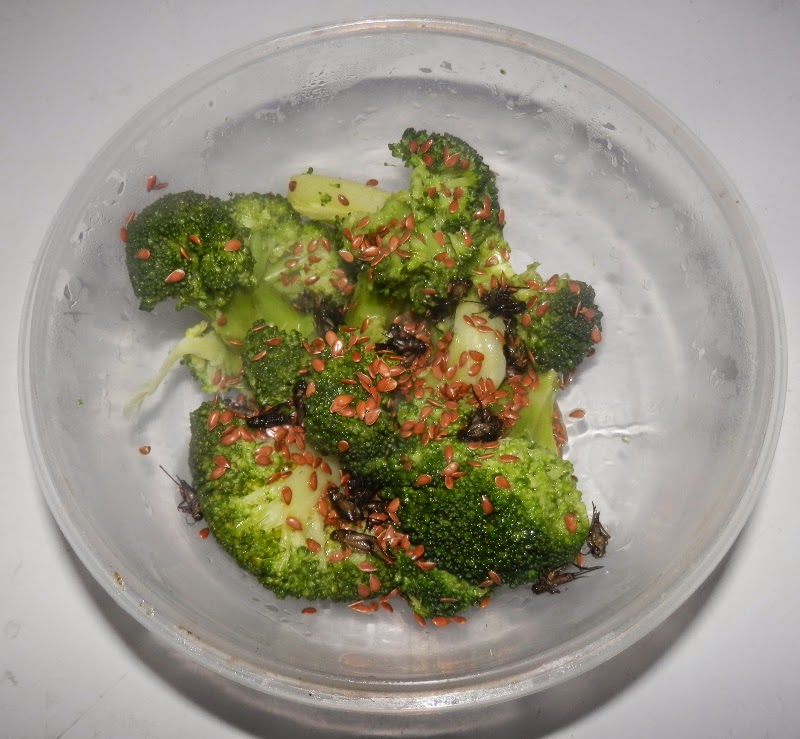
Field Cricket and Flaxseed Broccoli

Admittedly a lot of my recipes involve putting things on broccoli.  I think I already posted my recipe for flax seed broccoli, which I ate every damn day for probably two weeks a while ago.  It's easy:  Just add flaxseeds, sliced almonds, and extra virgin olive oil to broccoli.  Eat.

This is a variation on that, but instead of sliced almonds, I added sautéed field crickets and butter.

FYI: Crickets actually taste like a bizarre mix between shrimp and almonds anyway.  So it made perfect sense.

The sauté was done in some light olive oil and very briefly.  Crickets are tiny and therefore cook fast.  Meanwhile I made the broccoli and added a tablespoon of brown flaxseeds and a half tablespoon of Kerrygold Irish butter.  The crickets were placed on top of that.

This dish wasn't bad, but the problem is as follows:  The crickets didn't really add anything except protein.  And yeah, that's great, but if I'm going to add something I want to taste it.  I think if I did this again, I'd actually add the crickets from the recipe above instead of just sautéing them.